
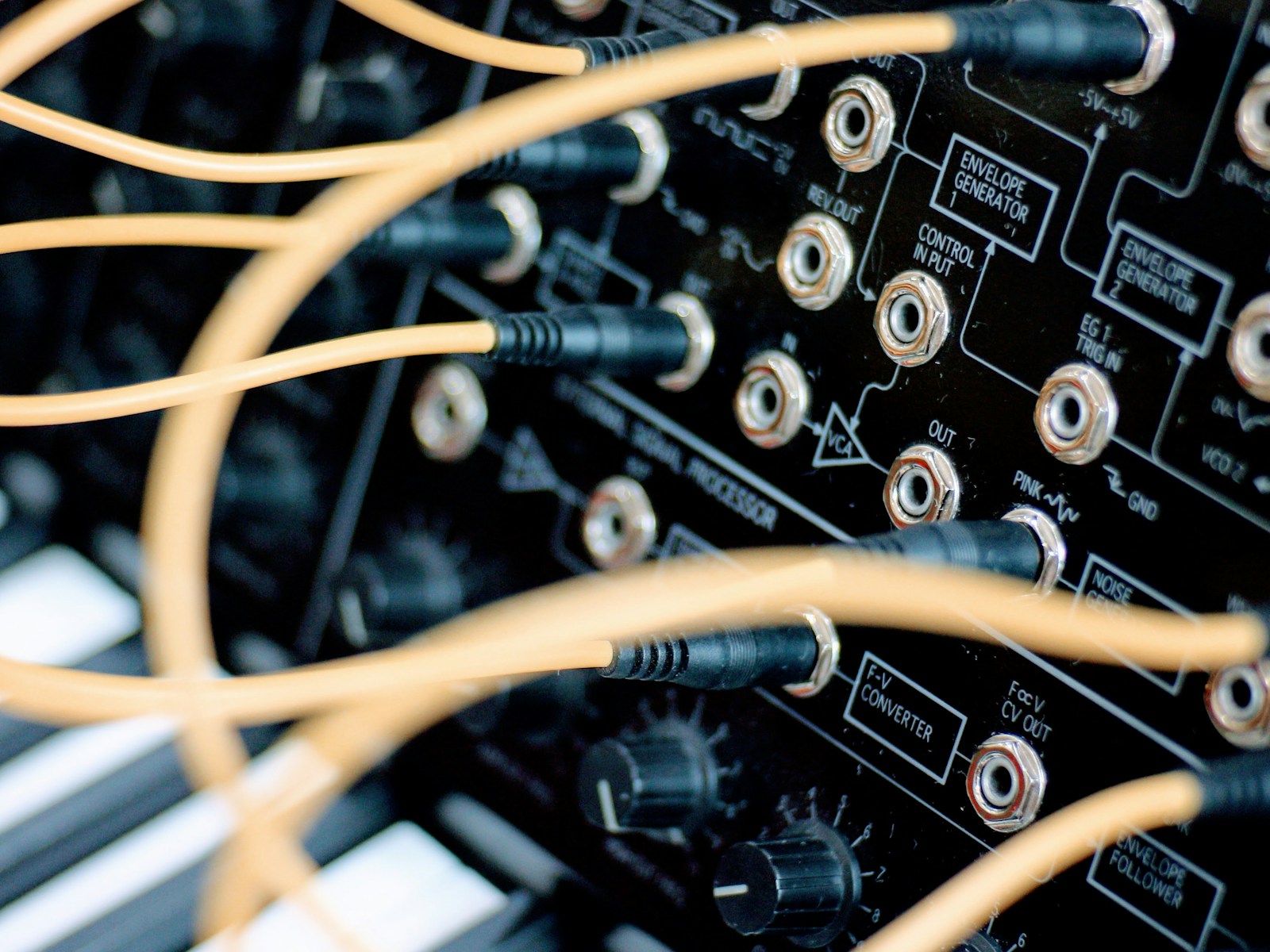
The modular synthesizer is a peculiar musical instrument: it has no keyboard, no fixed signal flow, no factory presets, and no obvious user interface. The working musician has to build the signal flow each time by physically connecting modules with patch cables, choosing which oscillator goes through which filter, which envelope shapes which amplitude, which low-frequency oscillator modulates which parameter. The format is more difficult to learn than any keyboard synthesizer, and it is also one of the most genuinely creative instruments available, because the player is composing both the music and the instrument simultaneously. This piece is a beginner’s working guide to what modular synthesis actually is, what the basic modules do, and how to start a system without spending more than the price of a decent keyboard synthesizer.
The aim is practical and non-mystified. Modular synthesis has accumulated substantial cultural mystique in the past fifteen years, and the marketing around it sometimes treats the format as a kind of esoteric art rather than as a technical practice with relatively well-defined component parts. The components are well-defined, and once understood, the apparent mystery dissolves into something more interesting: a system you can genuinely shape rather than receive.
What modular actually is
A modular synthesizer is a sound-producing instrument made of separate modules, each performing a single function (generating a tone, filtering it, shaping its volume over time, modulating a parameter), connected by patch cables that the user manually configures. The format dates to the early commercial synthesizers of the 1960s — the Moog Modular, the Buchla 100 series, the ARP 2500 — before the development of integrated keyboard synthesizers like the Minimoog (1970) that hardwired typical signal flows into a single instrument.
The modular format was largely displaced by integrated synthesizers from the early 1970s through the 1990s, then experienced a substantial revival starting in the late 1990s with the development of the Eurorack standard by Doepfer Musikelektronik. Eurorack defines module dimensions (3U high), power supply standards, and signal voltages that allow modules from different manufacturers to interoperate. The standard’s success — there are now several hundred Eurorack manufacturers globally — has made modular synthesis economically and technically accessible in ways that the original 1960s-1970s format never was.
The basic module categories
A working modular system needs at minimum the following module categories.
Voltage-controlled oscillator (VCO)
The VCO generates the basic tones. A typical VCO produces several waveform shapes simultaneously (sine, triangle, sawtooth, square or pulse), with the pitch controlled by an input voltage. The standard 1V/octave control voltage means a one-volt change at the pitch input produces an octave change in pitch. VCOs vary in tonal character, stability and feature set; entry-level VCOs cost approximately 200-400 EUR and high-end models can cost considerably more.
A starter system needs at least one VCO; many systems benefit from two so that detuned or harmonically related sounds can be combined.
Voltage-controlled filter (VCF)
The VCF shapes the harmonic content of the sound by attenuating frequencies above (low-pass), below (high-pass) or outside (band-pass) a cutoff frequency. The cutoff is voltage-controllable, which means it can be modulated by envelopes or LFOs to produce the swept-filter sounds characteristic of synthesizer music. Most VCFs include a resonance control that emphasises frequencies near the cutoff, producing the distinctive « wow » sound when swept.
Different filter designs produce substantially different tonal characters. The Moog ladder filter, the Roland TB-303 filter, the Buchla low-pass gate, the Oberheim SEM filter — each has its own signature, and modular users often own multiple filters for different applications.
Envelope generator (EG)
The envelope shapes the loudness of a sound over time, typically through four stages — attack, decay, sustain, release (ADSR) — though simpler AD or AR envelopes are also common. The envelope is triggered by gate signals (typically from a sequencer or keyboard) and outputs a control voltage that opens and closes a voltage-controlled amplifier (VCA).
Voltage-controlled amplifier (VCA)
The VCA controls the amplitude of an audio signal based on a control voltage. Coupled with an envelope generator, the VCA produces the characteristic temporal shape of synthesised notes. VCAs are also used as modulation depth controls, adjusting how strongly an LFO modulates a filter cutoff, for example.
Low-frequency oscillator (LFO)
An LFO is essentially an oscillator running at sub-audio frequencies (typically 0.01 Hz to 30 Hz), used to modulate other parameters. Common applications include vibrato (LFO modulating VCO pitch), tremolo (LFO modulating VCA), filter sweeps (LFO modulating VCF cutoff) and more complex rhythmic patterns.
Sequencer
A step sequencer plays a series of pitches (and often gates and other CVs) in succession, allowing automated melodic and rhythmic patterns. Hardware sequencers range from simple eight-step models to elaborate multi-track devices with complex programming features.
The starter system
A reasonable starter modular system, capable of producing varied and musically interesting sounds, needs approximately the following:
- 1 case with power supply (Tiptop Mantis, Doepfer A-100, or similar — around 400-700 EUR)
- 1-2 VCOs (200-500 EUR each)
- 1 VCF (150-400 EUR)
- 1-2 envelope generators (80-150 EUR each)
- 1-2 VCAs (60-150 EUR each)
- 1 LFO (80-200 EUR — sometimes integrated with envelope)
- 1 simple sequencer (150-400 EUR — Pamela’s NEW Workout, Doepfer A-155, or similar)
- 1 mixer/output module (60-200 EUR)
- Patch cables (50-100 EUR for a starter set)
Total cost runs approximately 1,500 to 3,500 EUR depending on module choices. This is comparable to a mid-tier integrated synthesizer and produces substantially more compositional flexibility, at the cost of greater learning curve.
The learning curve
The first three to six months of modular practice typically involve substantial confusion. The instrument has no manual in the traditional sense; learning happens through patching, experimenting, and gradually building intuitions about how modules interact. Several practical guidelines help reduce frustration during this period.
Start with simple patches. A basic synth voice (VCO into VCF into VCA, with envelope shaping the VCA, gate from sequencer triggering envelope, sequencer pitch CV controlling VCO) is sufficient for substantial musical work. Resist the temptation to add complexity until you have produced satisfying results with the simple version.
Document your patches. A simple notebook or photograph after each patching session lets you reproduce setups that worked well, and reveals patterns in your own working preferences over time.
Listen extensively. The modular tradition has substantial recorded history, including key albums by Klaus Schulze, Tangerine Dream, Wendy Carlos, Suzanne Ciani, and the more recent generation including Kaitlyn Aurelia Smith, Caterina Barbieri and Lorenzo Senni. Listening to how working modular musicians actually use the format teaches more than any tutorial.

The Eurorack ecosystem
The Eurorack format dominates the contemporary modular market, with several hundred manufacturers globally. Major manufacturers worth knowing about include:
- Make Noise (US): one of the most influential current manufacturers, with modules including Maths, DPO and the Wogglebug.
- Mutable Instruments (France): Émilie Gillet’s open-source designs (Plaits, Marbles, Beads, Stages) have been widely adopted; many of these designs are now produced by other manufacturers under the open-source license.
- Doepfer (Germany): the originator of Eurorack, still producing a comprehensive range of well-priced modules.
- Intellijel (Canada): polished modules with strong build quality.
- Verbos Electronics (US): Mark Verbos’s modules, drawing on the Buchla tradition.
- Mannequins (US): smaller manufacturer with distinctive design philosophy.
- ALM Busy Circuits (UK): UK-based manufacturer producing widely-used utility modules.
Other format options exist (Buchla 200e, Kilpatrick Audio, Serge format, the larger 5U format) but represent much smaller markets than Eurorack and are typically chosen for specific tonal preferences rather than for general modular practice.
Software modular alternatives
Several software environments allow modular-style patching without the hardware investment. VCV Rack, the most-used free software modular environment, has substantial functionality and a large library of free and paid modules that often replicate hardware Eurorack modules. Cherry Audio Voltage Modular and Reaktor Blocks from Native Instruments are commercial alternatives with their own ecosystem strengths.
Software modular is genuinely useful for learning the patching paradigm without financial commitment, and produces substantial sound quality. The hardware experience is different in tactile and workflow terms, but musically the software versions are capable of essentially equivalent output. Several professional musicians have built careers entirely on software modular systems.
What to expect from the format
Modular synthesis suits some musicians and not others. The format rewards patient exploration, comfort with unstructured creative process, willingness to compose by responding to what the instrument produces rather than executing a predetermined plan, and acceptance that the tools the user has chosen will shape the music made on them. Musicians who prefer to work from a fully formed composition that the instrument then realises tend to find modular frustrating; musicians who enjoy compositional discovery in real time tend to thrive in the format.
The financial commitment, while substantial in absolute terms, is comparable to other serious musical instruments. The intellectual commitment is higher than for most commercial synthesizers, but the return is an instrument that genuinely operates as a creative collaborator rather than as a fixed tool.
Frequently asked questions
Is modular better than a commercial synthesizer?
Different. Modular offers more compositional flexibility and tonal range; commercial synthesizers offer more immediate playability and presets. Choose based on which working style suits you.
Do I need to know electronics to use modular?
No. Patching is a learning process that does not require electrical engineering knowledge. Some users go on to build their own modules from kits, but this is optional.
How long does it take to make music with modular?
The first satisfying patches usually emerge within a few weeks of regular practice. Sophisticated musical use typically takes a year or more of sustained engagement.
The semi-modular alternative
For musicians intrigued by modular synthesis but unwilling to commit to a full Eurorack system, the semi-modular category provides a useful intermediate step. Semi-modular synthesizers have an internal default signal path (so they produce sound without any patching) but expose patch points that allow modular-style reconfiguration. The format combines the immediate playability of integrated synthesizers with the exploratory potential of modular.
The most established semi-modular instruments include the Moog Mother-32 and its successors (Subharmonicon, DFAM), the Make Noise 0-Coast, the Behringer Neutron and Crave, and the Roland Aira Compact line. Pricing ranges from approximately 200 EUR for the Behringer Crave to 800 EUR for the Moog Mother-32. Most semi-modular instruments use Eurorack-compatible patch points, which means they can be integrated into a larger modular system later if the user decides to expand.
For musicians who want to learn modular patching concepts without the substantial investment of a full system, a single semi-modular instrument paired with a basic stereo audio interface and a sequencer (either hardware or software-based) provides a complete entry point. Several professional electronic musicians, including the British producer Hainbach, have built substantial careers using primarily semi-modular and small-system modular setups, demonstrating that the larger systems are not strictly necessary for serious musical work.
Comparative analysis: hardware versus software modular
The choice between hardware and software modular involves trade-offs that depend on individual working styles. Hardware modular provides tactile interaction with knobs and patch cables, which many users find conducive to creative flow. The dedicated workspace and the time commitment of patching encourage sustained focused work that is more difficult to maintain in software environments where other applications and notifications compete for attention.
Software modular, primarily through VCV Rack but also through commercial alternatives, provides essentially unlimited module count without space constraints, automatic patch storage and recall, and the ability to integrate cleanly with DAWs for recording and sequencing. The 2024 release of VCV Rack 2 with its rebuilt graphics engine and substantial third-party module catalogue has substantially closed the gap between software and hardware modular for most working applications.
The honest assessment for most beginners is that VCV Rack provides a complete enough environment for several years of learning before the limitations of software become genuinely binding. Users who develop a sustained modular practice typically migrate to hardware over time, but the migration is optional rather than necessary. Several professional electronic musicians work primarily in software, with hardware additions only for specific tactile or tonal requirements.
Misconceptions about modular synthesis
Several persistent misconceptions about modular synthesis distort how the format is approached. The first is that modular is inherently expensive. The minimum useful modular system, including a starter case, basic modules and patch cables, can be built for under 1,500 EUR, which is comparable to a single mid-tier integrated synthesizer. The « modular is expensive » perception comes from the more elaborate systems showcased in social media, which represent end-state collections rather than starting points.
The second misconception is that modular requires extensive electronics knowledge. It does not. The Eurorack standard ensures that modules from different manufacturers can be connected without users needing to understand the underlying electrical engineering. Some users develop interest in module construction or modification, but this is an optional development from initial use rather than a prerequisite.
The third misconception is that modular is primarily for experimental or noise music. While the format certainly suits experimental work, modular synthesizers are widely used in mainstream electronic music, film scoring, ambient production and even pop production. Recent producers including Floating Points, Caribou and Bonobo have all incorporated substantial modular elements into commercial pop and electronic music releases.
The fourth misconception is that modular replaces other instruments. It does not, in practice. Most working electronic musicians who incorporate modular synthesis maintain a broader instrument collection including computers, traditional synthesizers, samplers and acoustic instruments. The modular system serves a specific creative function within the broader practice rather than substituting for the other tools.
The patching learning curve, in detail
For musicians beginning to learn modular synthesis, several specific learning sequences have worked well. The first three to six months should focus on basic synth voice patches: a single VCO into a VCF into a VCA, with envelope shaping the VCA, and a sequencer providing both pitch CV and gates. This minimum patch produces meaningful musical output and teaches the fundamental signal flow that more complex patches will build on.
Months six through twelve typically involve adding modulation complexity: LFOs modulating filter cutoffs, envelopes modulating pitch for vibrato or pitched percussion, sample-and-hold circuits creating quasi-random pitch sequences. The compositional possibilities expand substantially during this period, and many practitioners discover their personal modular style emerging from specific module combinations they find compelling.
Year two and beyond typically involves expanding the system based on accumulated taste and working method. Some musicians focus on west-coast synthesis (the Buchla tradition, with low-pass gates, complex oscillators and additive techniques); others on classic east-coast synthesis (the Moog tradition, with subtractive filtering and more conventional architecture); still others on rhythmic and sequencing-focused systems. The format rewards specialisation over time, with most accomplished modular practitioners developing distinctive personal systems that suit their compositional preferences.
Where to listen and learn
For musicians wanting to develop their understanding of modular through listening, several specific recordings provide excellent starting points. Suzanne Ciani’s Buchla Concerts 1975 documents one of the formative modular practices on the West Coast tradition. Klaus Schulze’s Timewind from 1975 represents the European modular tradition at its peak. Wendy Carlos’s Switched-On Bach, while not strictly modular, established many of the techniques that modular practitioners later developed.
For contemporary work, Caterina Barbieri’s Patterns of Consciousness and Spirit Exit demonstrate sophisticated modular composition in the 2020s. Kaitlyn Aurelia Smith’s Euclid and The Kid showcase the Buchla Music Easel tradition. Lorenzo Senni’s work explores the boundary between modular synthesis and dance music. The Nonclassical record label has released substantial modular-focused work from the contemporary European scene.
For instructional resources, the YouTube channel « Look Mum No Computer » provides accessible technical instruction. The « Synth Stuff » podcast by Lisa Bella Donna focuses on synthesis history and technique. The « I Dream of Wires » documentary and the accompanying book provide historical context for the format’s revival. The Loopop YouTube channel offers detailed module reviews that are useful for purchase decisions.
Further reading
The Wikipedia entry on modular synthesizers provides historical and technical context. The ModularGrid database is an essential planning resource for visualising and comparing modular system configurations. The Berklee College of Music Electronic Production and Design programme has published several free educational resources on synthesis fundamentals that translate directly to modular practice. Our archive on synthesis techniques is at techniques instrumentales, with broader production material at production musicale, and a separate thread on electronic music covering the broader genre context.
This article is for informational purposes and reflects publicly available technical and personal experience; module specifications, prices and availability change continuously, so verify current details with manufacturers before purchase.

Laisser un commentaire